![Protests held in Rome and several other cities across Italy against Israel following the attack on the Global Sumud Flotilla, which aimed to break the blockade on the Gaza Strip and deliver humanitarian aid in Italy on May 18, 2026. [Claudia Chieppa - Anadolu Agency]](https://i0.wp.com/www.middleeastmonitor.com/wp-content/uploads/2026/05/AA-20260518-41424748-41424743-THOUSANDS_MARCH_IN_ROME_IN_SUPPORT_OF_GLOBAL_SUMUD_FLOTILLA-scaled-e1779350833766.jpg?fit=920%2C613&ssl=1)
Israel’s politicians and generals have a strategy: not security, not coexistence. It is the oldest colonial formula in history: seize the land, expel the indigenous population, and then call the defenders terrorists.
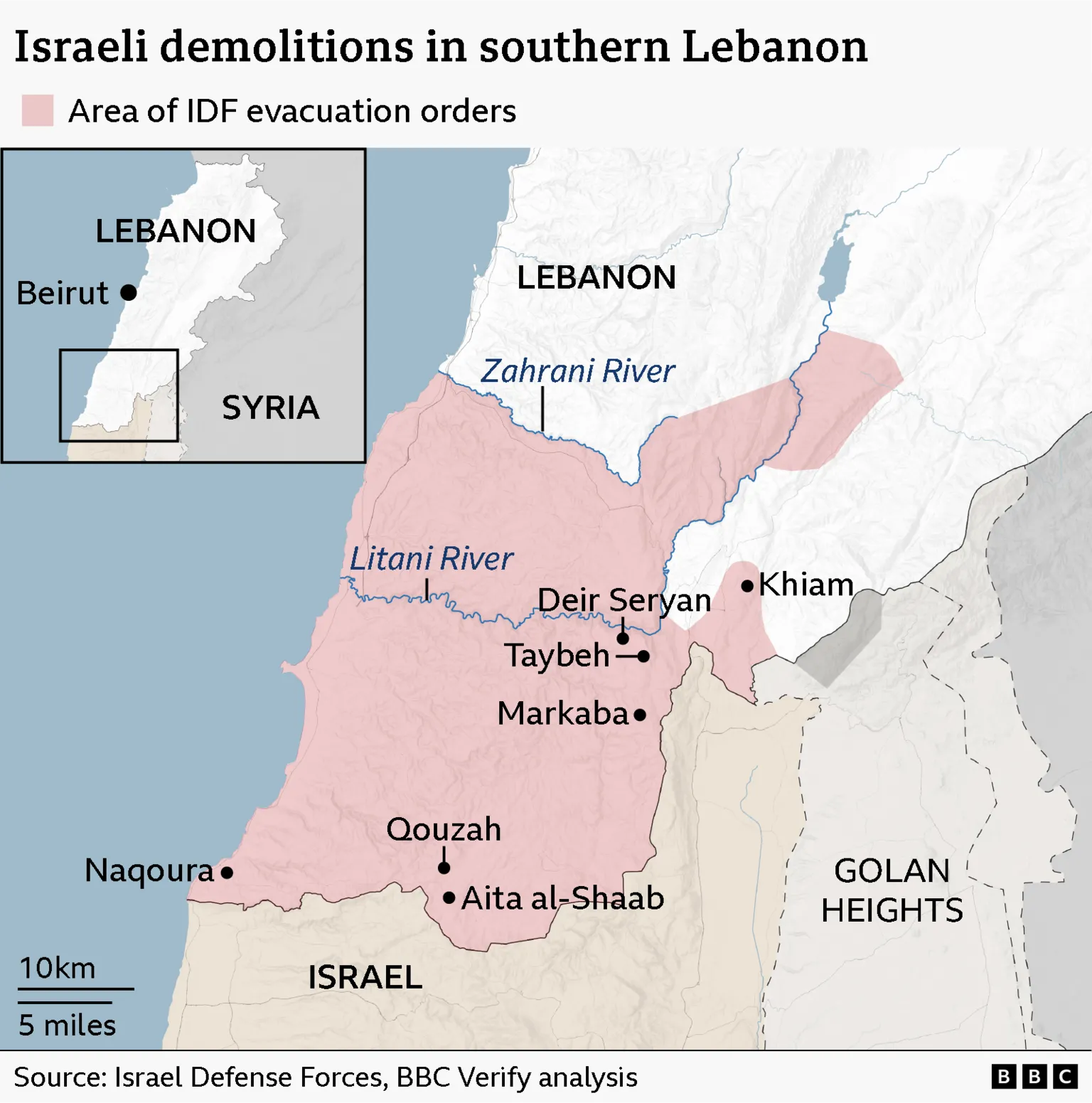
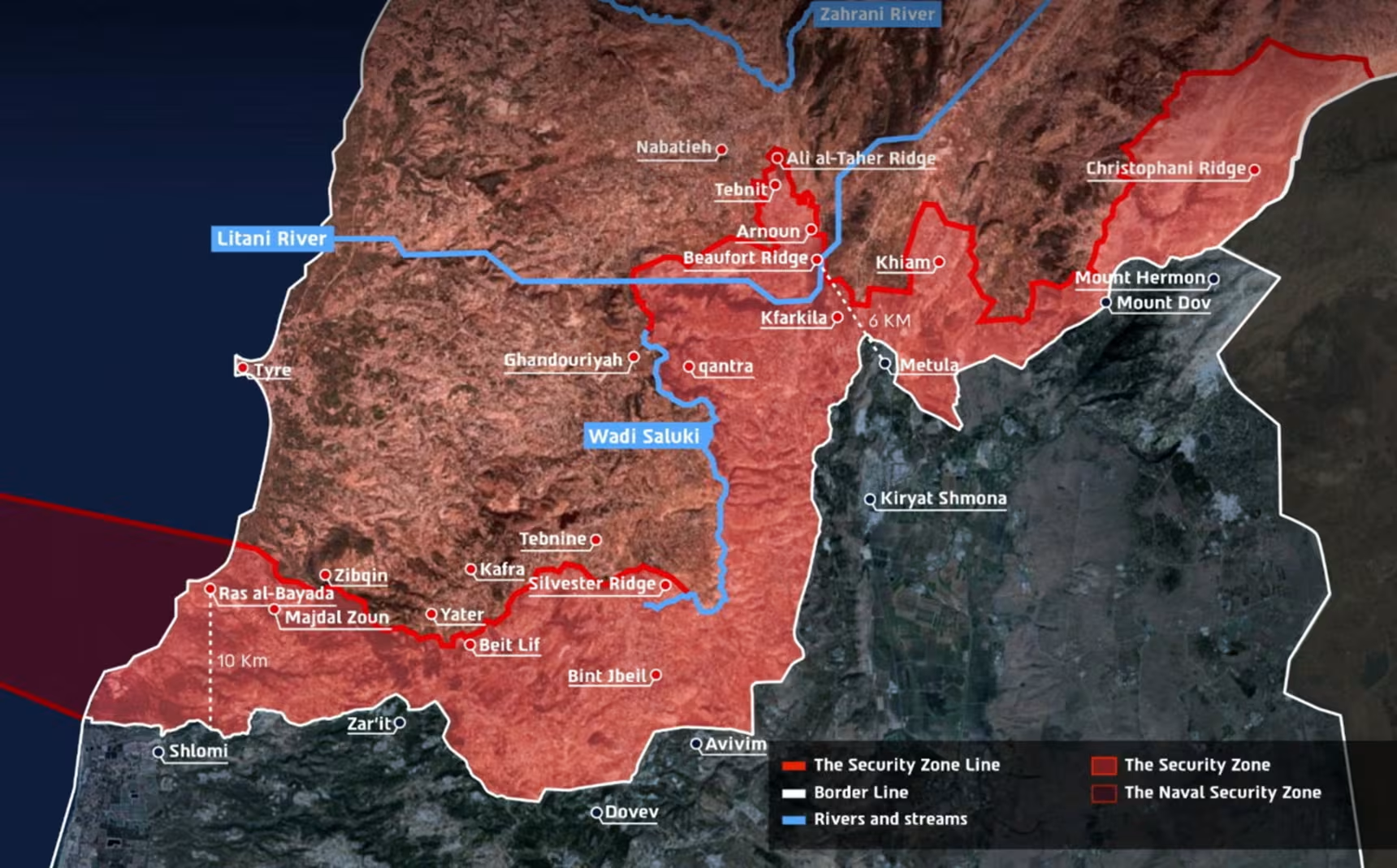
On March 16, Israel invaded South Lebanon under the pretext of protecting its Jewish-only colonies in the north. At first, it was a so-called security zone ranging from four to six miles inside Lebanon. This was followed by ordering the evacuation of towns and villages for an area of roughly 775 square miles, about a fifth of the entire country. Now, to shield its occupying army in the “security zone” it created weeks earlier to protect the Jewish-only colonies across the borders.
Over a million Lebanese were ethnically cleansed from their homes, not as a byproduct of war, but as explicit Israeli policy. Israeli Defense Minister, Israel Katz ordered his army to demolish Lebanese border villages and permanently occupy Lebanese territory up to the Litani River. He did not mince words about what those orders meant: Lebanese living in the so-called security zone “will not return,” he said. “None of them will return.” This is ethnic cleansing announced in a press release.
The Lebanese resistance was the only obstacle to Israel’s declared expansionist plans.
Outgunned, outmanned, and facing one of the most heavily armed militaries in the world, Lebanese fighters nonetheless waged a disciplined guerrilla campaign targeting the occupying military on Lebanese soil, not Israeli civilians.
In a fierce battle before the announced ceasefire, resistance fighters raided a heavily fortified Israeli military position, overran it, destroyed tanks, and killed four soldiers, including a battalion commander. They targeted a military force on occupied land, which is not only a moral right but a recognized right under international law.
The Israeli response, violating the just announced ceasefire, was asymmetrical, targeting Lebanese civilians and infrastructure to cause maximum harm. An act of vengeance, not war, revealing the moral rot at the core of Israel. National Security Minister Itamar Ben Gvir took to social media declaring “For every tear of an Israeli mother, a thousand Lebanese mothers should cry,” he wrote. “All of Lebanon should burn.” Israeli Finance Minister Bezalel Smotrich, called for “opening the gates of hell,” repeating almost verbatim what the Israeli prime minister declared, standing next to the U.S. Secretary of State on February 16, 2025, against Gaza. The same genocidal call was reiterated by his war minister threat in March 2025.
Same hate, same genocidal death cult, another target.
The “gates of hell” swung open. For the tear of every Jewish mother, of an occupying soldier killed on the battlefield, hundreds of goyim children lost their mothers and fathers when American-made and taxpayers paid, Israeli jets violated the announced ceasefire, raining more than 200 airstrikes on homes and civilian infrastructure across Lebanon.
The dozens murdered and hundreds injured were the goyim whose grief, in Ben Gvir’s calculus, exists only as ritual sacrifice on the altar of Zionist hatred.
Again, and as in Gaza before, the toll of killed wasn’t just an abstract number. For, my own cousin, Mohamed Fandi, from al Rashidia Palestinian refugee camp in South Lebanon. A husband and a father of seven who was murdered as he rested under the shade after a long day tending and harvesting citrus.
For Israel, killing one soldier justifies avenging his death by killing a laborer, a mother, a child — anyone to quench its insatiable culture of hate. The Western-managed media never points out that the Lebanese resistance targets the occupying army on Lebanese soil, while Israel’s response targets homes, hospitals, and civilian infrastructure. The asymmetry is deliberate, and the media’s silence about it is equally vulgar. Were the roles reversed, no Western outlet would miss the story, and “Israeli civilians’ would be named, photographed, mourned on loop, their faces burned into the collective conscience of a watching world. But Lebanese and Palestinian civilians murdered in pure Israeli vengeance are granted no such dignity. Their deaths are buried, just a number in a paragraph, a paragraph at the bottom of a story, a story no one reads.
Israel calls every terrorist attack as “targeted operations.” The number of murdered civilians and the rubble of homes and hospitals in Gaza and Lebanon tell a different story. And this is catching the world’s attention.
In fact, it’s not merely criticism coming from voices traditionally opposed to Israel. It comes from figures and institutions that have long normalized or excused Israeli war crimes hiding behind the German Holocaust. When figures such as CNN’s Jake Tapper — a long time Israeli apologist — describes Ben Gvir’s remarks as “hideous” and targeting nearly six million people. Or British Foreign Secretary, Yvette Cooper condemning the remarks as “abhorrent.”
Still, the deeper problem is that even these voices fall short of recognizing these genocidal statements for what they are: not provocation or political posturing, but an inherent state policy. Responsibility is often narrowed by blaming a single minister or even the internationally indicted prime minister, while avoiding a broader examination of the political project that enables such policies. The result is familiar: statements of concern, ritual condemnation, and expressions of outrage lacking meaningful measures to stop the very Israeli actions they censure.
Lebanon is not the exception. The same Israeli formula plays out in Gaza, in Syria, and the West Bank: occupy the territory, demolish the homes, expel the people, then grant the Israeli army “full freedom of action” with “no restriction…” to strike at will while expecting the occupied to remain still.
“Gates of hell” and “all of Lebanon should burn,” language of collective punishment that even the architects of the Holocaust dared not articulate in public. This very discourse, imported by the European political Zionist ideology, is not just political rhetoric. It is the declared policy of those who claim descent from the survivors of Europe’s “hell,” advocating hell on Gaza and Lebanon, before a global audience too paralyzed, or too cowardly, to stop it.
The views expressed in this article belong to the author and do not necessarily reflect the editorial policy of Middle East Monitor.
 Unless otherwise stated in the article above, this work by Middle East Monitor is licensed under a Creative Commons Attribution-NonCommercial-ShareAlike 4.0 International License. If the image(s) bear our credit, this license also applies to them. What does that mean? For other permissions, please contact us.
Spotted an error on this page? Let us know
Latest news
See all