
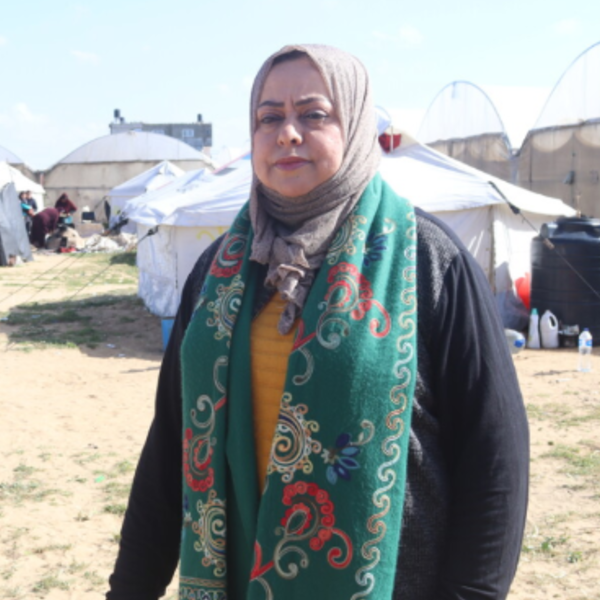
![Buthaina Subeh in Gaza in January 2023. [Photo: Wattan Media/ActionAid]](https://i0.wp.com/www.middleeastmonitor.com/wp-content/uploads/2026/10/image-9-1-1.png?fit=920%2C613&ssl=1)
When I entered Gaza through the crossing, I was shocked and stunned by what I saw. Looking to my right and left, all the houses were destroyed, leaving no trace. The streets were unrecognizable. Every street had a name, but I couldn’t identify them, there were no landmarks. The destruction was utter and unnatural.
I returned to Gaza in May after two years of living in Egypt. I don’t regret going back to Gaza. But I’m still in shock, unable to accept life and the situation people are living in. The situation is terrible, unnatural.
Since the genocide began in October 2023, things have been extremely difficult. We were deeply shocked by the reality of what was happening in Gaza: the destruction, the displacement, and the killing of people.
This war, of course, had a grave impact on us and changed the course of our lives. This also affected our work and changed the nature of our role as women leaders and advocates in the field of women’s rights.
Carrying out our work in Rafah at the beginning was difficult. During the first three months, I refused to ask the social workers and lawyers to work inside the shelters out of fear for their safety. But little by little, we began working, knowing this war could last a long time. It is extremely difficult to be responsible for your team, to ask your own team to put themselves at risk, when, at any moment, they could be exposed to bombardment or death.
Then our office was destroyed, and its assets and resources were lost, so I had to start managing and directing the association from my home. I lived in a two-storey house in Rafah and I hosted between 35 and 40 displaced people there, yet I still managed to use part of the ground floor for work. We were able to continue providing services from my home despite the serious risks, because the Israeli occupation was targeting us, targeting anyone trying to help people, whether through offices, warehouses, or vehicles used for humanitarian response.
The area where I lived in Rafah was sheltering almost 1.2 million people, due to the mass displacement from the north to the south. We distributed hygiene and food assistance packages to displaced families in tents and UNRWA school shelters at a time when government shelters were not yet operating. At the time, we had a kitchen in Rafah allowing us to cook regularly for people. That was an important part of our work in addition to distributing fresh water to the tents. We also built women’s restrooms among the tents in informal shelters.

I had two main reasons for going to Egypt. I was scheduled for surgery in November 2023, but I ignored it. I thought that being in the middle of a war was not the right time for surgery. But eventually, my condition worsened, and I became more ill and exhausted. I decided I had to undergo treatment.
It was also because I felt I was in real danger. I had a feeling that Rafah was nearing its end. I was terrified for my children. I was having nightmares that made my fear for them even stronger and that led me to decide to go to Egypt.
It was not an easy decision. It is not easy to leave your home, your family, and your work, and even my entry into Egypt was not guaranteed.
I was not granted a medical referral for medical evacuation. If I had waited for medical evacuation for my turn to come and had been lost in the bureaucracy, only God knows whether I would have survived. So I decided to pay for my treatment out of pocket. I paid $7,500 (£5,580) to be able to leave and that was only for me to pass through the Rafah crossing into Egypt. I also paid $3,000 (£2,230) for my daughter to be allowed to leave with me.
Thankfully, I was financially able to afford leaving and receiving treatment. Sadly, most people in Gaza were not and this left many patients, especially women and children, at risk of death.
It was a very difficult journey. All my children were with me when I was at the Rafah crossing. I was crying so hard, thinking I might never see them again, afraid that while going to Egypt, I might lose them, because the possibility that I or they may die or never seeing each other was real.
I thought I would go for a couple of months and register my children so they could come to Egypt while I received treatment, and then I would return to Gaza, to my home, my husband, and my work. I wanted to return to my life in Gaza once I knew my children were safe.
Then what I feared most happened. I travelled on the 29th of April 2024, and on the 5th of May, the Rafah crossing was permanently closed. It remained closed until February 2026.
I found myself stranded, separated from my kids. Those were two very difficult years for me. I was constantly trying to ensure their safety, as they were in danger while I was safe and this was an agonizing guilt. I was given sedatives so I could sleep, instead of staying awake with worry. Whenever there was shelling near them in Al-Mawasi, Khan Yunis, my daughter and I were gripped by terror. We couldn’t enjoy life, we couldn’t feel any sort of safety or mental peace. We lived in a state of constant tension.
Then came the news that my home had been completely destroyed. I hadn’t even finished paying for it yet; I still owed the half amount in installments and outstanding checks and I had lived there for less than two years. All the toil and hardship of a lifetime spent building a home for ourselves and our children to settle down, it vanished in the blink of an eye. It was devastating news; I fell ill for a week after hearing it and seeing the images of the house’s total destruction.
Things were extremely difficult; the suffering and hardship were very real. Yet I remained fully engaged in my work on a daily basis, around the clock. Sometimes I worked normal hours, other times, the internet was so poor in Gaza that I had to communicate at night. We spoke whenever possible, at any time, even on weekends. I did not have a single day off to rest. God helped Wefaq remain standing, continue working, and keep helping people.

The decision to return to Gaza was inevitable. What should I do in Egypt? Just live in a safe house? Of course not. I had to return to my Homeland, to my children, my family, my home, my work, my friends, my colleagues, and everyone.
Honestly, as soon as the crossing opened, I registered on the embassy’s website to return. What delayed me a bit was completing my medical treatment to ensure my health. I didn’t feel safe in Egypt, and I did not feel joy in Egypt during my two years because, truly, the land, the homeland, and the family are the only safe havens.
The days leading up to my return were filled with anxiety. My name was on the lists, but no one knew when the approval would come. I was in a terrible hurry and wanted to go back and see the children. I was afraid the crossing might close again before I could return. I was constantly stressed, anxious, and making calls, desperately wanting someone to help me get back quickly.
Then I returned to Gaza on May 13th, 2026. The journey back was incredibly tiring, it’s inhumane. We sat in the sun for three or four hours to be checked waiting for the Israelis to tell the Europeans and the Palestinian side that “it’s ok, send their group”. There are no toilets. It was very hot that day and you could not drink water, so that you would not have to go to the bathroom and in the end when I arrived at the [Israeli crossing] and we were searched and we got on the buses, I got dizzy from sunstroke, where I fainted.
At the Israeli crossing there was humiliation and inspection. I saw people who were harassed and had many of their belongings confiscated. There was disrespect. We remained on the bus waiting after we were searched and checked, sitting in the bus, locked up and suffocating, and there was no air conditioning. We remained waiting on the bus from 5:30 PM until 2:30 AM, when the buses finally set off.
It was a shock to me after I entered Gaza and the bus started moving. People began to cry at the sheer scale of the devastation we had witnessed in Rafah city and along our route from the crossing to Nasser Hospital in Khan Younis.
I now live in a tent in the Al-Mawasi area of Khan Younis in the Sultan Mahmoud camp, which houses no fewer than 200 families. The situation is terrible, unnatural. I’m still honestly in shock and I can’t accept life at its natural rhythm
Imagine living in a tent, just a tarpaulin, on sand. I am considered much better than others: I have a large tent for my children and a room roofed with corrugated zinc. I have a bed, and I bought a wardrobe. I’m trying to cope. Other people’s situation is extremely bad. I’m still in shock at how people can bear this and live normally.

Daily life in Gaza is very difficult. There’s no water and people have to wait for a water tanker to come so they can fill up. Goods are available now, but it’s very expensive and not everyone can afford it; most people rely on charities but even many charities have stopped operating.
The health situation is dire; garbage is everywhere and basically there’s no sewage system. The pipes could burst in some streets, making them impassable. There’s also a widespread infestation of rodents and fleas in most of the tents and not everyone can afford pesticides or rodent control products, which could lead to the spread of epidemics. Most people go to hospitals knowing beforehand that there is no treatment, no medicine, and no equipment. The most important thing Gaza needs now is the rehabilitation of hospitals and the establishment of various medical points to provide health services.
We at the Wefaq Foundation are working on a humanitarian response to meet people’s needs, providing hygiene kits, dignity kits, food parcels, vegetable baskets, hot meals, children’s clothing, women’s clothing, and tents. We are also doing our basic work of providing multi-sectoral services to women who are victims of violence, and women and children at risk. We provide psychological support, consultations, psychotherapy also, health services, social services, legal services, and consultations, even representation through referrals. We have also implemented many economic empowerment projects to develop businesses such as bakeries, mills, spice shops, restaurants, food products, and sweets.
Buthaina, pictured back in Gaza this month
Gaza needs everything. But first, Gaza needs an end to the Israeli occupation and its reconstruction, so that people can live a dignified, protected, and honorable life, far from the humiliation and degradation that people are currently living in and the restoration of rights to their owners.
The views expressed in this article belong to the author and do not necessarily reflect the editorial policy of Middle East Monitor.
 Unless otherwise stated in the article above, this work by Middle East Monitor is licensed under a Creative Commons Attribution-NonCommercial-ShareAlike 4.0 International License. If the image(s) bear our credit, this license also applies to them. What does that mean? For other permissions, please contact us.
Spotted an error on this page? Let us know
Latest news
See all


