

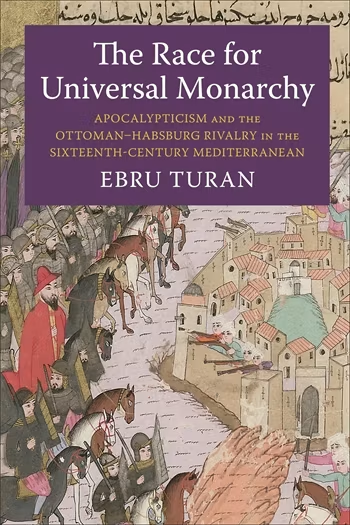

The sixteenth century saw the rise of two Mediterranean empires driven by apocalyptic fever who sought to bring Christianity and Islam together under the rule of one emperor. Ebru Turan’s new book The Race for Universal Monarchy: Apocalypticism and the Ottoman-Habsburg Rivalry in the Sixteenth-Century Mediterranean looks at the Ottoman Habsburg rivalry through the lens of competing ideologies shaped by overlapping historical events. The Crusades shifted political ideologies in both Europe and the Middle East creating a need to justify acquiring power in line with religious end times beliefs. Both Charles V, King of Spain and Archduke of Austria, and Suleyman I, the Ottoman Sultan, not only viewed their clash as part of the usual political rivalry, both saw their leadership as representing a universal vision for peace and unity of the Mediterranean that was connected to a religious imperative. Turan putting the Habsburg and Ottoman next to each other comparatively changes the way historians understand the development of both empires.
The Ottoman ghaza tradition is something that changes in light of this study. Traditionally, the Ottoman state has been depicted as being governed by an aggressive crazed Islamist expansionism looking to subjugate Christian Europe, but what Turan argues is the Ottoman ghaza policies were rooted in responding to Muslim fears of Christian expansionism that not only sought to subjugate Muslims, but also eliminate Islam altogether. ‘From their earliest appearance, the Ottoman rulers positioned themselves as the bulwark of Islam against the aggression of Christendom.’ In other words, the ghaza was viewed by the Ottomans as a defensive posture against crusader attacks, but it also provided the Ottomans with the justification that it should be the leader of the Islamic world as only they could halt crusader expansionism that would usher in an apocalyptic era.
‘Habsburg universalism, centered on holding the imperial dignity and uniting the Eastern and Western Roman Empires under Habsburg rule, was grounded in a crusading ideology that called for the destruction of Islam as a religion and political sovereignty.’ The Habsburg dynasty actively positioned themselves to be the universal monarchy of Christendom and only unity under them could the Muslims be driven back. Similar to the Ottomans, an apocalyptic framework guided their political claims and served as justification for expansionism. The Habsburgs positioned themselves in an apocalyptic narrative rooted in the legend of the Last World Emperor. The tradition could be traced back to a seventh-century Syriac text written in the aftermath of the Arab conquests. The text prophesied the emergence of a divinely appointed Roman emperor that would emerge at the end times and would lead the Christians to victory and conquest of the Holy Land. All would convert to Christianity when this happened. After the Ottomans conquered Constantinople/Istanbul in 1453, this apocalyptic tradition reached fever pitch.
While Turan has provided detailed political history, her perspective does remind me of French historian of the Mediterranean Fernand Braudel, who is included in the book’s literature review, as Braudel argued that the Mediterranean shared a unique unity and shared historical destiny determined by massive economic expansion, climate, demography and monetary expansion led to the emergence of both Habsburg and Ottomans. While this is not necessarily Turan’s argument, it is clear that a shared destiny was a key way both empires saw each other. Perhaps the most interesting way this can be seen is the way both empires saw themselves as inheritors of the Roman Empire. The Ottomans included Caesar as part of the Sultan’s title and the Habsburg’s held the title of Holy Roman Emperor under Charles V. For the Ottomans revitalising the Romans as a shared cultural and historical force bringing Muslims and Christians together, formed a key part of the Ottomans universal empire vision. As they saw it, ‘This vision promised to eliminate war and conflict between the two spheres, paving the way for the establishment of absolute peace, harmony, and justice, as prophesied.’
The Race For Universal Monarchy offers a comprehensive political and ideological history driving the clash of empires in the sixteenth-century. The world after the Habsburg-Ottoman empires looks fundamentally different to the world before it. While the fall of the western Roman empire gave way to the emergence of city states in the Mediterranean, the sixteenth-century would see the development of stronger superstructure states paving the way towards the world we inhabit now. By putting aside cultural prejudice and examining the two empires next to each other, we can see how these developments occurred and it allows us to ask bigger questions about the formation of Europe, the Middle East and North Africa. Turan reads both European and Ottoman sources giving us a 360 view of these developments. The Race for Universal Monarchy is a fun, informative and engaging read.
 Unless otherwise stated in the article above, this work by Middle East Monitor is licensed under a Creative Commons Attribution-NonCommercial-ShareAlike 4.0 International License. If the image(s) bear our credit, this license also applies to them. What does that mean? For other permissions, please contact us.
Spotted an error on this page? Let us know
Latest news
See all


