

Thousands of demonstrators have taken to the streets across Latin America in solidarity with Palestine, as Brazil approaches a closely contested presidential runoff between President Luiz Inácio Lula da Silva, known for his pro-Palestinian stance, and pro-Israel Senator Flávio Bolsonaro.
The demonstrations formed part of a global campaign involving more than 200 organisations in over 60 countries, calling for an end to arms transfers to Israel and stronger international measures to hold it accountable for violations of international law.
Organised by the Global Alliance for Palestine, the international mobilisation brought together trade unions, student movements, human rights organisations and grassroots solidarity groups. Demonstrations and solidarity activities took place in Brazil, Mexico, Chile, Uruguay and Peru, as activists called for increased political, economic and diplomatic pressure on Israel.
In São Paulo, Brazil’s Unified Workers’ Central (CUT) joined the mobilisation, announcing the participation of healthcare workers demanding the release of Dr Hussam Abu Safiya, director of Kamal Adwan Hospital in northern Gaza, and other detained Palestinian medical personnel. The union also called for the protection of Palestinian hospitals and healthcare workers.
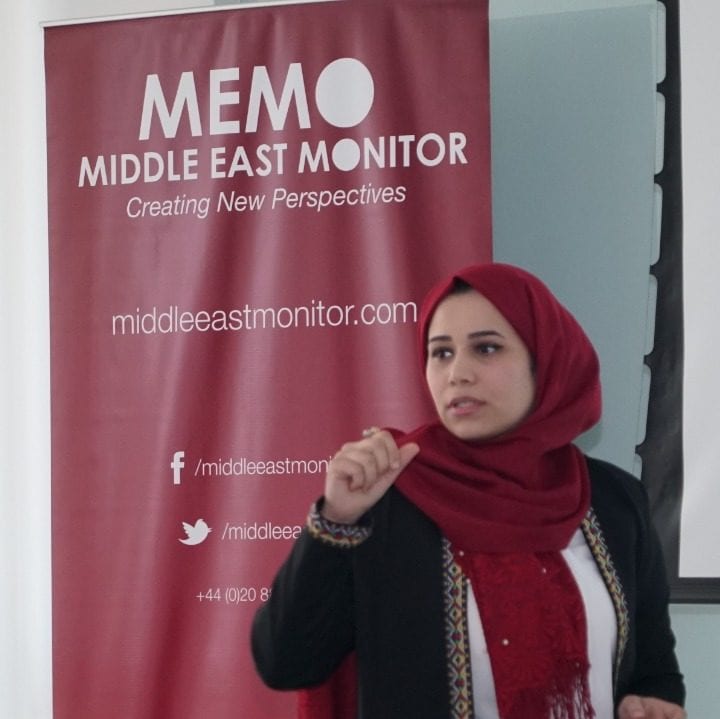
Soraya Misleh, a Palestinian-Brazilian activist, member of the Brazilian Press Union and the Coordination Committee of the Front for the Defence of the Palestinian People, and an activist in Brazil’s Boycott, Divestment and Sanctions (BDS) movement, warned that the presidential election could have consequences for Brazil’s position on Palestine and its relations with Israel.
Misleh warned that the growing influence of far-right governments across Latin America could lead to stronger economic, military and diplomatic relations with Israel, potentially undermining international efforts to hold it accountable.
She said Brazil’s political direction was particularly significant given the country’s regional influence, warning that developments elsewhere in Latin America should raise concerns among Brazilians ahead of the vote.
“This should raise even greater alarm among Brazilians at this moment of elections in Brazil, whose role is crucial in Latin America,” she said.
Misleh also criticised the limited international measures taken against Israel, arguing that too few governments had severed relations or implemented concrete steps to hold it accountable over the war in Gaza. “There is still a long road ahead in the struggle to isolate the State of Israel internationally, with very few countries having broken relations with Israel and adopted concrete measures,” she said.
She called for stronger solidarity with Palestinians and continued pressure on governments to pursue accountability, linking these demands to wider political developments across Latin America. “This makes it even more necessary to strengthen mobilisation and solidarity with the Palestinian people in order to continue demanding accountability,” she said.
Misleh added that efforts to hold Israel accountable should be accompanied by opposition to far-right political movements in the region. “The struggle for accountability must be combined with the struggle against the far right throughout Latin America, including in Brazil,” she said.
View this post on Instagram
Mohamad El Kadri, a founding member of the Front for the Defence of the Palestinian People in São Paulo, told MEMO that demonstrations across Brazil and Latin America were helping transform solidarity with Palestine into a sustained awareness campaign.
“The importance of these demonstrations lies in turning solidarity with Palestine from a reaction to immediate events into a continuous process of raising awareness about Palestinian society, its history and developments in the Palestinian territories,” he said.
El Kadri noted that similar activities had been organised in several Brazilian cities and states, reaching wider sections of society and raising awareness of the Palestinian cause.
READ: Brazil’s Lula warns of lasting impact of Gaza war and criticises UN inaction
He also highlighted the participation of trade unions and healthcare workers, particularly in the campaign demanding the release of Palestinian doctor Hussam Abu Safiya.
“The involvement of doctors and healthcare workers draws particular attention to the conditions facing Palestinian medical personnel and facilities,” he said.
El Kadri added that union participation was helping extend the solidarity movement beyond traditional political activism into broader professional and social sectors, amid reports of Palestinian healthcare workers being detained, killed or injured during Israel’s war on Gaza.
View this post on Instagram
In Colombia, the government’s recent rapprochement with Israel has raised concerns among pro-Palestinian activists over the future of international efforts to hold Israel accountable.
Misleh pointed to recent developments in Colombia as an example of how changes in political leadership can reshape a country’s approach to Israel. “Unfortunately, with the far-right Abelardo de la Espriella assuming Colombia’s presidency in August 2026, he decided to reverse the measures adopted by Gustavo Petro regarding recognition of the genocide and intervention in the case brought by South Africa against Israel,” Misleh said.
She argued that Colombia’s policy reversal reflected a wider regional trend among far-right governments seeking closer relations with Israel. “All far-right governments in Latin America are committed to this alignment and to deepening economic, military and diplomatic relations with Israel,” she said.
For Misleh, the developments in Colombia carry particular significance as Brazil approaches its presidential runoff. “This should raise even greater alarm among Brazilians at this moment of elections in Brazil, whose role is crucial in Latin America,” she added.
Her remarks come amid growing concerns among Palestine solidarity activists about the potential implications of political changes in major Latin American countries for international efforts to hold Israel accountable.
She warned that international efforts to isolate Israel remained limited, noting that relatively few countries had severed diplomatic relations or adopted concrete measures. “There is still a long road ahead in the struggle to isolate the State of Israel internationally, with very few countries having broken relations with Israel and adopted concrete measures,” she said.
Misleh called for continued mobilisation in solidarity with Palestinians, arguing that such efforts were increasingly important amid the changing political landscape in Latin America. “This is certainly a step backwards, which makes it even more necessary to strengthen mobilisation and solidarity with the Palestinian people in order to continue demanding accountability,” she said.
“The struggle for accountability must be combined with the struggle against the far right throughout Latin America, including in Brazil,” she added.
View this post on Instagram
In Chile, thousands of people took to the streets of Santiago in a show of solidarity with Palestine. Organised by student groups, trade unions and human rights organisations, the march began near the Universidad Católica metro station and continued along Alameda Avenue towards Los Héroes. Demonstrators carried Palestinian flags and banners condemning Israel’s war on Gaza.
In neighbouring Uruguay, thousands marched through Montevideo under the slogan “Free Palestine or Barbarism”, calling on the government to take stronger action against Israel.
In Peru, student groups and human rights organisations joined the wave of solidarity, including representatives from the Pontifical Catholic University of Peru, Free Palestine–Peru and the National University of San Marcos. The groups called for demonstrations in Lima, urging the government to take a stronger position on the war in Gaza and reconsider its relations with Israel.
BLOG: Diplomats to MEMO: Colombia’s ICJ withdrawal reflects alignment with US
 Unless otherwise stated in the article above, this work by Middle East Monitor is licensed under a Creative Commons Attribution-NonCommercial-ShareAlike 4.0 International License. If the image(s) bear our credit, this license also applies to them. What does that mean? For other permissions, please contact us.
Spotted an error on this page? Let us know
Latest news
See all


