
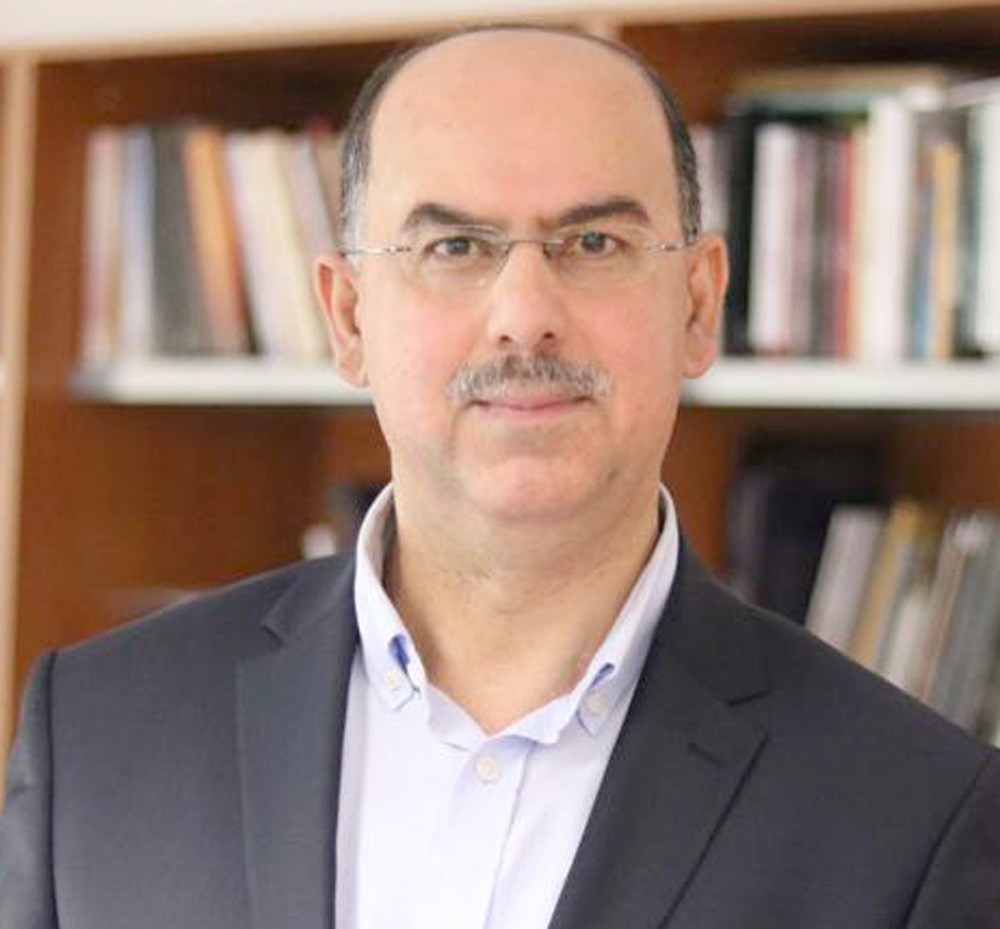
![Head of the National Wisdom Movement Ammar al-Hakim leaves after voting at Al Rasheed Hotel as the country holds first elections for provincial councils within a decade in Baghdad's Green Zone, Iraq on December 18, 2023. [Murtadha Al-Sudani - Anadolu Agency]](https://i0.wp.com/www.middleeastmonitor.com/wp-content/uploads/2023/12/AA-20231218-33210307-33210298-IRAQ_HOLDS_FIRST_ELECTIONS_FOR_PROVINCIAL_COUNCILS_IN_A_DECADE.jpg?fit=920%2C613&ssl=1)
In Iraq, political positions are not measured by programs—they’re measured by vocabulary. In a country restructured after 2003 on the basis of sectarian quotas, words have become keys to deciphering agendas, not intentions. So it’s fair to ask: How many times has Ammar al-Hakim said “Shia”? And how often has he said “Iraq”? What does it mean when Mohammed al-Halbousi becomes not a political counterpart to al-Hakim, but a sectarian equivalent? Especially as sectarian rhetoric intensifies ahead of Iraq’s upcoming parliamentary elections on 11 November.
It’s not difficult to deconstruct the formula behind Iraq’s political process: Politicians are not elected to represent a nation, but to complete a sectarian equation—one imposed by necessity, not conviction.
I’m fortunate. Artificial intelligence never tires of counting. It counts words, and it counts motives. It helps me audit Ammar al-Hakim’s speeches, where the word “Shia” recurs like a magic key to unlock every political stance. “Iraq,” by contrast, appears timidly—mentioned only as a footnote to the sect.
Can a politician define himself by a sect? Can a political project be built on the fear of minority status and the myth of victimhood? Al-Hakim doesn’t shy away. He is the product of a sectarian school of thought, raised in Iran, taught that loyalty belongs not to a homeland but to a doctrine. In one speech, he declared: “We are proud of our Shia identity, and we must protect it from marginalisation.” But who is marginalising whom? And who is building what, on whose back?
Mohammed al-Halbousi, by contrast, was not born into sectarianism. He was created—summoned as a necessity, not a choice. A necessity for Iran-backed parties in Iraq to produce a Sunni counterweight—not to represent Sunnis, but to balance the equation. Thus, al-Halbousi became a sectarian equivalent, not a political leader. And Iraq disappeared from both men’s vocabulary.
Here, we borrow from T.S. Eliot’s concept of the “objective correlative” and replace it with a “sectarian equivalent.” Eliot argued that emotion is only understood through its external counterpart. In Iraq, sectarianism is the emotion—and the politician is its counterpart.
But is this representation? Or is it roleplay in a tired sectarian theatre, with transparent political fiction? Can national identity be the last thing mentioned in a political speech?
A report by the UK’s Chatham House put it bluntly: “Iraqi elections change nothing—they merely redistribute power among sectarian elites accustomed to dividing the state.” And the Atlantic Council notes: “Iraq’s political discourse remains driven by sectarian lines, despite repeated reform efforts.”
![Former Iraqi Parliament Speaker Mohammed al-Halbousi, who was ousted after the decision of Iraq's top court revoking the parliamentary membership of the parliament speaker with accusation of attempting to normalise ties with Israel and signing an agreement with BGR US lobbying group, holds a press conference in Baghdad, Iraq on November 30, 2023. [Murtadha Al-Sudani - Anadolu Agency]](https://i0.wp.com/www.middleeastmonitor.com/wp-content/uploads/2023/12/AA-20231130-33069900-33069892-OUSTED_IRAQI_PARLIAMENT_SPEAKER_MOHAMMED_ALHALBOUSIS_PRESS_CONFERENCE_IN_BAGHDAD.jpg?resize=920%2C613&ssl=1)
Former Iraqi Parliament Speaker Mohammed al-Halbousi, who was ousted after the decision of Iraq’s top court revoking the parliamentary membership of the parliament speaker with accusation of attempting to normalise ties with Israel and signing an agreement with BGR US lobbying group, holds a press conference in Baghdad, Iraq on November 30, 2023. [Murtadha Al-Sudani – Anadolu Agency]
Since 2003, Iraq’s political process has not been built on the idea of a state, but on the fragility of sectarianism. No one is elected to represent Iraqis. They are elected to represent their sect—or to complete someone else’s sectarian formula. Al-Hakim doesn’t hide his affiliation; he declares it. Al-Halbousi doesn’t hide his function; he performs it.
But can we judge al-Halbousi by the same measure as al-Hakim? Al-Hakim was raised in a sectarian environment inside Iran. He fought against his supposed countrymen in the ranks of a foreign army during the Iran-Iraq war. He was taught that Iraq was a deferred idea—secondary to the doctrine. Al-Halbousi, on the other hand, was selected. Chosen not to lead, but to balance. Chosen not to represent, but to complete.
In this context, the question becomes more urgent: Can an Iraqi politician break free from his sectarian function? Can he redefine himself outside the equation? Or has sectarianism become a political destiny that cannot be broken?
As the 11 November elections approach, the question returns: Will Iraqis vote for their identity? Or will they choose the sectarian equivalent that resembles them more than it resembles their country?
Perhaps Iraq doesn’t need someone to represent it. It needs someone who forgets how to represent. Someone who forgets the sect—and remembers the nation. But is he allowed to do so? Or has the sectarian equation become a law that cannot be broken, only reproduced every four years?
In the end, a politician is not measured by votes. He is measured by how many times he says “Iraq” without following it with the name of his sect. That’s what algorithms don’t do. But they reveal what’s left unsaid—about al-Hakim, al-Halbousi, and the rest of the political detritus in a counterfeit Iraq that works tirelessly to kill the real one.
The views expressed in this article belong to the author and do not necessarily reflect the editorial policy of Middle East Monitor.
 Unless otherwise stated in the article above, this work by Middle East Monitor is licensed under a Creative Commons Attribution-NonCommercial-ShareAlike 4.0 International License. If the image(s) bear our credit, this license also applies to them. What does that mean? For other permissions, please contact us.
Spotted an error on this page? Let us know
Latest news
See all


