
![The Palestinian activist Rawa Alsagheer, [FB]](https://i0.wp.com/www.middleeastmonitor.com/wp-content/uploads/2026/09/rawa.jpg?fit=920%2C613&ssl=1)
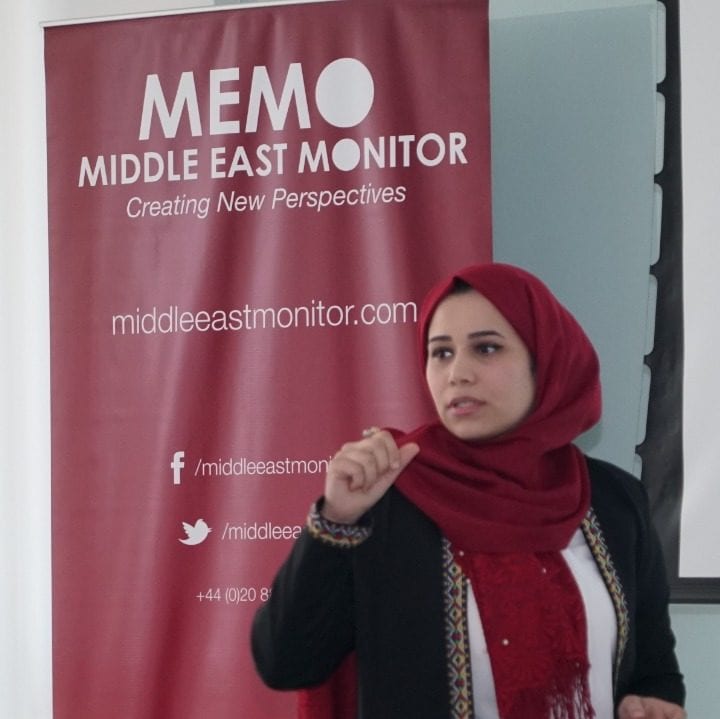
The United States’ decision to impose counterterrorism sanctions on Palestinian activist Rawa Alsagheer and the Masar Badil movement has triggered expressions of solidarity across Brazil and Latin America, with activists condemning the measure as an attempt to criminalise Palestinian political organising and solidarity work.
The US Treasury Department announced on August 26 that Masar Badil, also known as the Palestinian Alternative Revolutionary Path Movement, had been added to its sanctions list under Executive Order 13224, Washington’s main legal framework for imposing counterterrorism-related financial restrictions.
Alsagheer, a Palestinian activist based in Brazil, and Germany-based Zaid Abdulnasser were also designated on the grounds that they are leaders or officials of Masar Badil. The Treasury described Masar Badil as being linked to and acting on behalf of the Samidoun Palestinian Prisoner Solidarity Network, which Washington previously sanctioned in 2024.
For Alsagheer, however, the announcement prompted an initially unexpected response. “I found out about the sanction because the entire movement was placed under these sanctions, on this US list,” she told MEMO. “I found out through the movement, and honestly, I ended up laughing about it for three days straight.”
She said she regarded being personally targeted by Washington less as an intimidation tactic than as an indication that Palestinian activism was attracting the attention of the US government.
“I don’t think I’ve done enough yet in my struggle to deserve being placed on this list, to be so honoured as to be persecuted by the US government,” Alsagheer said.
“This sanction doesn’t affect me at all; it doesn’t affect my life here,” she added.
READ: Washington reclaims Latin America through energy as Israel returns to Caracas
Under the US measures, however, any property or financial interests belonging to designated individuals or entities that are in the United States or under the possession or control of US persons must be blocked and reported to the Treasury Department’s Office of Foreign Assets Control.
US persons are generally barred from carrying out transactions involving designated individuals or organisations, including providing funds, goods or services to them. Foreign financial institutions may also risk exposure to secondary sanctions for knowingly facilitating certain significant transactions involving those designated.
The Treasury Department said Masar Badil was a “front” for Samidoun and alleged that the two organisations share fundraising mechanisms as well as senior leaders and executive committee members. It designated Masar Badil under Executive Order 13224 for what it described as being controlled or directed by, or acting on behalf of, Samidoun.
Alsagheer and Abdulnasser were separately designated because the US government identifies them as leaders or officials of Masar Badil.
Washington included the measures in what it described as a broader campaign against “violent far-left terrorist networks”, alongside actions targeting other organisations.
The designation therefore places Alsagheer’s case within a larger dispute over the US government’s increasing use of counterterrorism authorities against organisations it considers connected to politically motivated violence, while those targeted and their supporters argue that such measures risk conflating political activism with terrorism.
For Palestine solidarity groups in Brazil and Latin America, the case has consequently taken on significance beyond the financial restrictions imposed on a single activist or movement. They see it as part of a wider confrontation over the political space available to Palestinian organisations and movements supporting Palestinian rights.
Alsagheer described the decision as part of a broader effort to restrict Palestine solidarity work in Brazil. “This is an attempt to silence the Palestinian voice within Brazil, to criminalise the Palestinian voice in Brazil as well as all activists,” she said.
“It is an attempt to make us afraid, to make us scared so that we won’t speak.” Her comments reflect concerns expressed by Palestine solidarity activists and organisations in Brazil and elsewhere in Latin America, who have portrayed the sanctions as an escalation in efforts to associate pro-Palestine political activism with security threats.
However, She framed her own activism within the wider experience of Palestinians in Gaza, the occupied West Bank and Palestinian communities displaced or dispossessed since 1948.
“We don’t believe that we have done enough yet for the Palestinian struggle,” she said. “Everything that we are trying to do as Palestinian activists, as activists supporting Palestine and standing in solidarity with Palestine, is very little compared with the enormous sacrifice of the Palestinian people in the Gaza Strip, the West Bank, and also the territories occupied in 1948.”
For Alsagheer, the sanctions will not lead her or the movement to retreat from their political positions. “It is extremely important for us to understand that the struggle will never stop,” she said.
She described the liberation of Palestine as inseparable from what she called the defeat of Zionism, connecting the Palestinian struggle to a broader opposition to imperialism and capitalism.
“They can call us whatever they want,” Alsagheer said, “but our struggle will continue until victory and liberation, from the river to the sea.”
From Bolivia to Colombia: Is the pro-Palestine Hague Group beginning to fall apart?
Solidarity statements supporting Alsagheer and Masar Badil have rejected the use of terrorism designations against Palestinian activists and political movements, warning that such measures could create wider legal, political and financial pressure on Palestine solidarity networks.
Supporters have rallied around slogans including “Resistance is not a crime” and “No to the criminalisation of the struggle for Palestine”, while defending what they describe as the right to organise against Israeli occupation, colonialism and apartheid.
Alsagheer said such pressure would not alter the movement’s political activity. “What we can say as a Palestinian movement is: good luck to them, because our struggle continues,” she said.
“This is not the first time, and it will not be the last time, that we will be considered terrorists, sanctioned, or treated in this way.” She added that the designation had reinforced rather than weakened her political convictions.
“This only confirms to us that we are on the right side of history,” she said, “and it also confirms that our voices are bothering them.”
The views expressed in this article belong to the author and do not necessarily reflect the editorial policy of Middle East Monitor.
 Unless otherwise stated in the article above, this work by Middle East Monitor is licensed under a Creative Commons Attribution-NonCommercial-ShareAlike 4.0 International License. If the image(s) bear our credit, this license also applies to them. What does that mean? For other permissions, please contact us.
Spotted an error on this page? Let us know
Latest news
See all


