

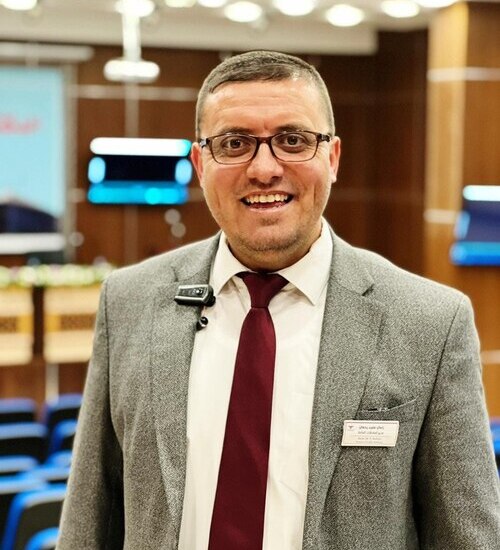
For Ali Nattat, the day begins with a look at the sky. In Gaza, the sunlight falling on his solar panels determines whether he can keep his neighbourhood connected to the outside world.
Unlike many homes nearby, Nattat’s modest house survived the airstrikes. It now houses a small internet network that supports his family and provides work for five employees. For displaced families and people working remotely on his street, it also provides a vital means of communication.
The network runs entirely on solar energy. Nattat has four small panels of his own and uses additional panels borrowed from a neighbour in exchange for free electricity. Together, they charge salvaged batteries that keep the equipment running after sunset.
But the system is fragile. Cloudy weather limits how much electricity the panels generate, leaving less power available at night.
“When my system abruptly dies at night, it doesn’t just cut my income; it paralyses the entire neighborhood,” Nattat said.


A connection to an injured daughter
For Abu Firas, 50, the network allows him to stay in touch with his daughter, who is receiving medical treatment in Egypt.
An airstrike destroyed his home and killed his wife. He now lives alone in the kitchen where he works, while the rest of his family have fled to Egypt.
He relies on Nattat’s network to make daily video calls to his daughter. When the batteries run out and the connection fails, Abu Firas must turn to expensive international mobile roaming to hear her voice, adding to his financial difficulties.
His dependence on the network is one reason Nattat feels unable to step away from it, even during the night.
Sharing limited power
The electricity generated by the panels must also meet the needs of Nattat’s household.
His wife, Areej, said the family uses some of the power to run a small freezer, allowing them to sell chilled water to people living in a nearby displacement camp. The sales provide an additional income.
Nattat’s parents and other relatives also rely on the system to charge their phones and power essential lights. As the batteries run low, he switches off other electrical appliances to keep the internet equipment working for as long as possible.
READ: UN: 950,000 displaced people in Gaza face flood risks this winter
“My dream is simply to achieve basic electrical stability for my network,” he said. “This internet business doesn’t just feed my immediate family; it is the sole source of income for five workers I employ.”
Yet replacing worn-out equipment or buying a more reliable system is costly.
Prices are at approximately $970 and a lithium-based solar power system at around $25,900. A basic installation also requires a panel and wiring, adding to the expense.
Those unable to afford their own equipment must pay for access to electricity. Charges cited for solar-powered phone-charging services range from approximately $0.32 to $0.65 per phone, while electricity supplied by private neighbourhood diesel generators can cost up to $11.30 per kilowatt-hour.
For families with little income, even charging a phone becomes another expense competing with daily necessities.
Broken sleep to keep the network running
Nattat’s mornings are divided between household responsibilities and earning a living. He collects water from a distribution truck, goes to the market and opens his small shop. Alongside those tasks, he manages the internet network from his living room.
“Almost everyone on my block relies solely on me to check if their families are safe,” he said.
After sunset, his attention turns to the batteries. He must balance keeping the network available against preserving enough charge to restart it the following morning.
He describes going to bed around midnight and waking again at 2.30am to inspect the system. When the remaining charge falls too low, he has to switch off the equipment.
“Flicking that switch feels like cutting a medical lifeline,” he said.
By 6.30am, Nattat is awake again to prepare the system for the day as the panels begin generating electricity. He aims to have the full network running about an hour and a half later, when residents need it for work and contact with their families.
The routine leaves him with little uninterrupted sleep. Each evening brings the same uncertainty: whether the batteries will last, when he will need to disconnect the network and who will be waiting to make a call.
For Nattat, a reliable electricity supply would mean a more secure livelihood and a chance to rest. For Abu Firas, it would mean being able to check on his injured daughter without worrying that the connection will disappear.
OPINION: Gaza’s displaced face a deadly choice: collapsing buildings or flooded tents
The views expressed in this article belong to the author and do not necessarily reflect the editorial policy of Middle East Monitor.
 Unless otherwise stated in the article above, this work by Middle East Monitor is licensed under a Creative Commons Attribution-NonCommercial-ShareAlike 4.0 International License. If the image(s) bear our credit, this license also applies to them. What does that mean? For other permissions, please contact us.
Spotted an error on this page? Let us know
Latest news
See all


