

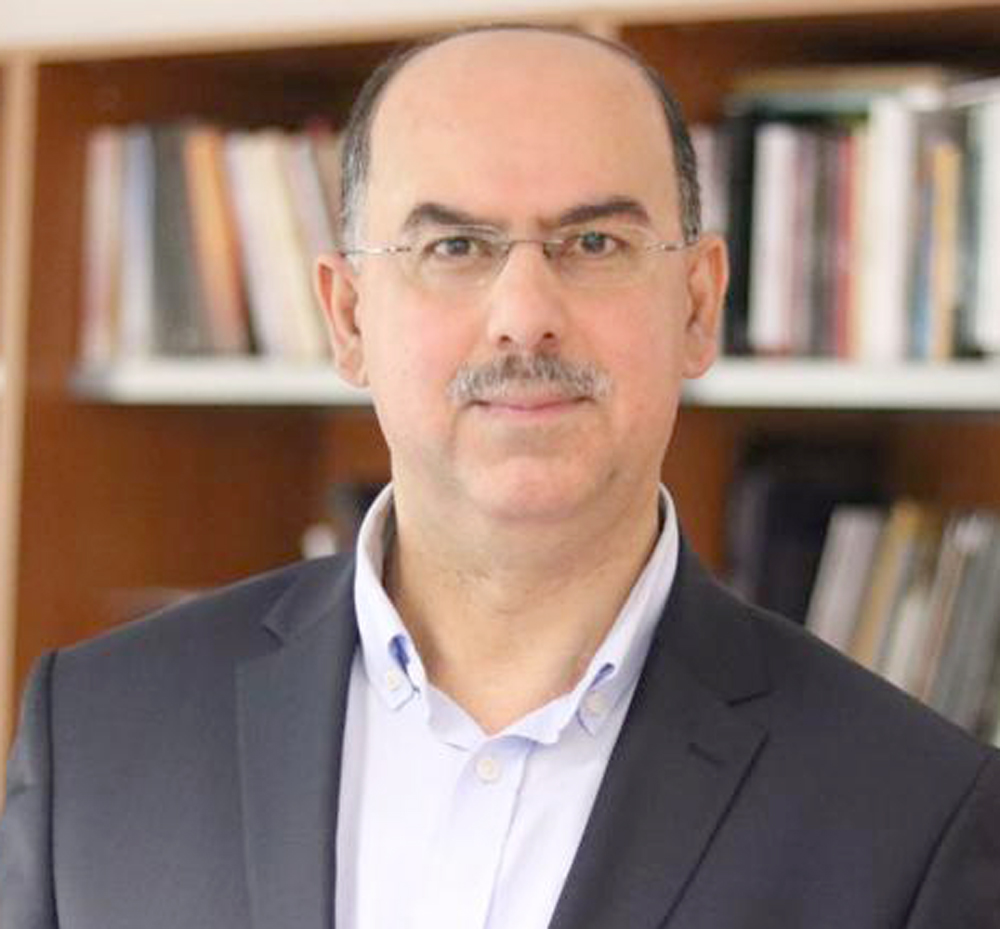
We ought to treat with considerable scepticism the terse communiqué issued by the media office of Iraq’s Supreme Judicial Council regarding the meeting between its president, Faiq Zaidan, and former British Prime Minister Tony Blair in London on Thursday, 12th November.
This wariness stems not merely from the fact that the two men represent intersecting facets of Iraq’s post-2003 political fracture and institutional corruption, but because the recent track records of both are bound up in an intricate web of lucrative political and financial arrangements. Both figures have been profiled in Western reporting as political operators who have amassed extraordinary influence and wealth through the corridors of power. Consequently, it defies credulity to take the official narrative at face value—that Blair and Zaidan sat down merely to discuss “constitutional texts and the independence of the Iraqi judiciary.”
On the contrary, every indicator and precedent points toward a far more pressing question: what substantial consultancy or financial arrangement is currently being brokered between Tony Blair’s political advisory apparatus and the power brokers of Baghdad?
To grasp the true nature of this encounter, one must examine the radical transformation of Faiq Zaidan’s position within the Iraqi power equation, as documented by international think tanks and investigative outlets. In a critical assessment, Jonathan Spyer, Executive Director of the Middle East Center for Reporting and Analysis (MECRA) and author of Days of the Fall: A Reporter’s Journey in the Syria and Iraq Wars, observes that Zaidan has effectively stepped into “the role once played by Abu Mahdi al-Muhandis, the former deputy head of the Popular Mobilisation Forces—managing the political landscape from behind the scenes.” Spyer argues that any Western bet on Zaidan to curb Iranian influence is doomed from the outset, given his organic ties to that very axis.
The American outlet RealClearWorld goes even further in an extensive investigative report that dubs Zaidan the “King of Iraq.”
While the head of the judiciary in functioning democracies acts as an independent arbiter upholding the rule of law, Zaidan, the report notes, has transformed himself in Baghdad into the country’s de facto ruler and supreme political power broker—seen daily holding back-to-back meetings with leaders of political parties and armed militias.
The same report cites investigative testimonies detailing how Zaidan—who ascended with the direct backing of Qasem Soleimani and Abu Mahdi al-Muhandis prior to their assassination in early 2020—became the “custodian of Iran’s legacy inside Iraq, overseer of patronage networks, and godfather of political and financial extortion” by accumulating compromising dossiers on senior officials and prominent businessmen. More alarming still is the testimony of a senior source within the Central Bank of Iraq, who described the scale of judicial coercion: “We have been reduced to worthless clerks. Orders come down to us, and if we fail to comply, we are immediately served with a judicial writ from a junior judge ordering us to execute them”—a mechanism used to funnel vast sums of money through front companies that appear Iraqi on paper while serving Tehran’s economic interests.
READ: When the ladder collapses
Taken together, these facts make clear that Faiq Zaidan is no mere jurist seeking an exchange of legal expertise with a former British premier; he is a central political and financial actor holding the levers of power in Baghdad. In a political ecosystem governed by cross-border transactionalism, a figure of Zaidan’s stature does not travel to London for intellectual tourism or protocol pleasantries.
A man who dictates the rhythm of state institutions and capital at home understands that preserving such leverage—and expanding his room for manoeuvre—requires a “Western bridge”: an interlocutor possessing an influential network, the capacity to launder political narratives, and the ability to secure major consultancy contracts or projects under the banner of “reform” and “institutional modernisation.”
It is precisely here that Zaidan’s trajectory intersects with that of a man who has mastered the art of converting former political office into multimillion-pound contracts.
Sitting across the table in London is Tony Blair, a politician widely described in the British press as a master of the “revolving door”—the mechanism enabling former senior officials to monetise their global connections and past office to build transnational consultancy empires.
According to investigations by Britain’s The Sunday Telegraph, this financial model has generated a personal fortune for Blair unmatched by any former British prime minister—estimated at between £20 million and £50 million—through providing “advisory services” to autocratic regimes and oil-rich states. Following the fall of his former financial ally, Colonel Muammar Gaddafi, Blair turned to advising Kazakhstan’s long-time ruler, Nursultan Nazarbayev. His firm, Tony Blair Associates, also secured a $43 million contract with the Kuwaiti authorities to draft reform blueprints, alongside £710,000 in profits generated through opaque web-based companies uncovered by the same newspaper.
What defines the post-Downing Street Blair model is a remarkable ability to repackage financial and political self-interest in the soft, technocratic language of “institutional reform,” “modernisation,” and “capacity building”—while the practical outcome is opening doors to contracts and influence for clients seeking international cover or a strategic foothold.
When this profit-driven consultancy logic meets a figure like Zaidan, who dominates Iraq’s decision-making apparatus, viewing their encounter through the prism of a “deal” is not idle speculation, but hard-headed realism.
Each possesses precisely what the other requires: Zaidan holds the keys to influence, dossiers, and capital in Iraq, while Blair commands an international network and the machinery of Western political and institutional rehabilitation.
Where Iraq is specifically concerned, Blair’s financial record raises profound ethical and political questions. The Daily Mail previously revealed that Blair went to considerable lengths to conceal lucrative consultancy arrangements with the South Korean oil firm UI Energy Corporation, which operated across Iraq, including the Kurdistan Region—pocketing millions of pounds in commissions since 2007. Those revelations prompted Conservative MP Douglas Carswell to brand Blair’s deals as “sordid,” while Liberal Democrat MP Norman Baker asserted that the contracts proved the former prime minister “had his political positions up for sale” and that his involvement in the Iraq War was partly driven by the pursuit of personal financial gain.
Nor did the matter end there. Subsequent reporting indicated that Blair received £1 million annually as a consultant to help facilitate contracts for developing the Zubair oil field in Basra—a glaring irony that undermines his repeated insistence that the 2003 invasion of Iraq had nothing to do with oil wealth.
Similarly, The Mail on Sunday reported that Blair accepted £90,000 to visit a methanol plant in Azerbaijan owned by Nizami Piriyev, a tycoon with extensive commercial interests spanning Russia, Syria, and Iran.
Recalling Blair’s financial footprint across oil, gas, and cross-border consultancy contracts—including commercial ties to figures whose interests intersect with Iran, Syria, and Russia—places the London meeting in stark relief. Iraq, transformed over more than two decades into an arena contested by networks of patronage and political capital, is scarcely immune to grand transactional politics. Any political or advisory arrangement quietly brokered between a dominant power centre in Baghdad and an international consultancy led by Blair carries a strong likelihood of being a major financial and political deal extending far beyond the stated “constitutional consultations”—whether involving state advisory contracts, front-company ventures, or leveraging Western influence to ease mounting political and media pressure.
READ: Republicans lost the election. Trump keeps talking
Tony Blair, whose political legacy remains under severe moral indictment—exemplified by the late South African Archbishop and Nobel Peace Laureate Desmond Tutu refusing to share a stage with him at an international summit over his role in the Iraq invasion and its catastrophic toll on hundreds of thousands of Iraqis—knows precisely how to deploy his international public relations expertise on behalf of those who command power and money in Baghdad.
Conversely, Faiq Zaidan, facing growing scrutiny and mounting dossiers in the US Congress and Western media over his role in entrenching Iranian influence and undermining judicial independence, stands in acute need of a seasoned Western intermediary of Blair’s calibre to polish his image, open backchannels, or structure international consultancy agreements that lend his authority a veneer of Western legitimacy.
Thus, when Iraq’s shadow “King” sits down in London with the godfather of the “revolving door,” official platitudes about “judicial independence and constitutional progress” amount to little more than a thin diplomatic smokescreen. The recent history of both men confirms that the language of figures, consultancy contracts, and traded influence is the only dialect fluently spoken behind closed doors.
The views expressed in this article belong to the author and do not necessarily reflect the editorial policy of Middle East Monitor.
 Unless otherwise stated in the article above, this work by Middle East Monitor is licensed under a Creative Commons Attribution-NonCommercial-ShareAlike 4.0 International License. If the image(s) bear our credit, this license also applies to them. What does that mean? For other permissions, please contact us.
Spotted an error on this page? Let us know
Latest news
See all


